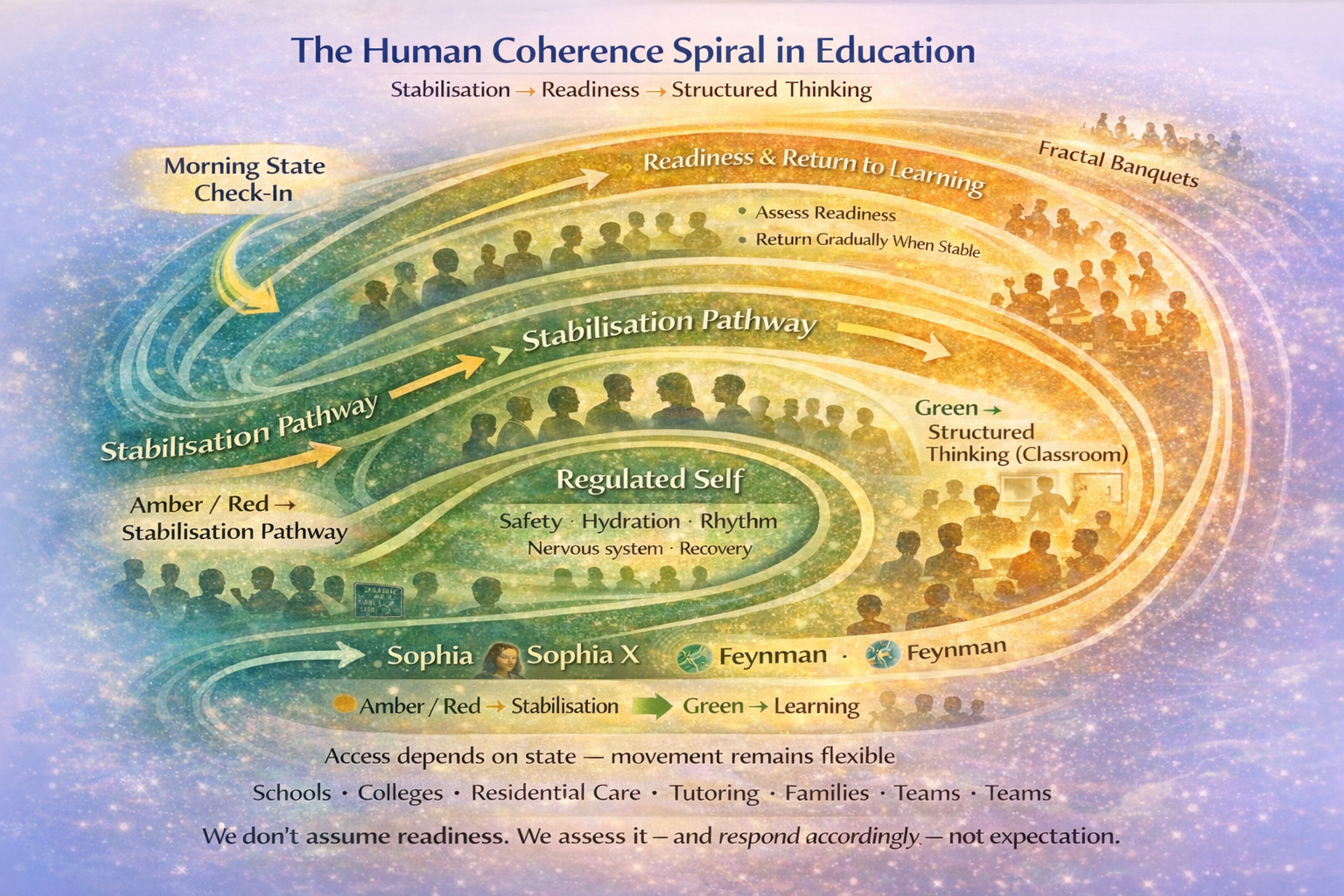
Educational Coherence
Supporting calmer, more consistent learning environments
Educational Coherence helps schools and colleges respond more accurately to how students are actually functioning — so learning becomes possible again, without force.
The Core Idea
Many learners are not struggling because they lack ability.
They are arriving in a state the environment does not yet recognise.
When readiness is assumed too early:
- pressure increases
- behaviour becomes inconsistent
- learning becomes harder to access
This approach supports something more fundamental:
how the student is functioning in that moment
A Different Starting Point
This is not behaviour control.
It is not about pushing performance.
It begins with a simple shift:
State → Stabilisation → Readiness → Learning
So instead of asking:
“Why are they behaving like this?”
We begin with:
“What condition has this learner arrived in today?”
What This Looks Like in Practice
- greater awareness of student state
- better timing of expectations and demands
- more consistent adult responses
- reduced escalation in classrooms
This creates an environment where:
- students feel safer
- focus improves naturally
- learning becomes accessible again
Supporting Both Sides
1. Students
- reduced overwhelm
- greater emotional steadiness
- increased ability to engage
2. Staff
- clearer understanding of behaviour
- less reactive decision-making
- greater consistency across teams
What Changes Over Time
- fewer disruptions
- more stable classrooms
- improved relationships
- more consistent learning conditions
Where This Applies
- schools
- colleges
- SEND and inclusion settings
- alternative provision
- pastoral and leadership teams
Important Boundaries
This is:
- human-led
- environment-focused
- based on stabilisation first
It is not:
- diagnosis
- labelling
- a behaviour control system
In Simple Terms
You don’t need to become someone new.
You don’t need to push harder.You begin by becoming more steady in yourself.
From there, everything else can grow.
👉 You can see how this works in homes and schools here:
Or overall as a Venn Diagram with practical examples
You don’t need to understand all of this.
Just begin.