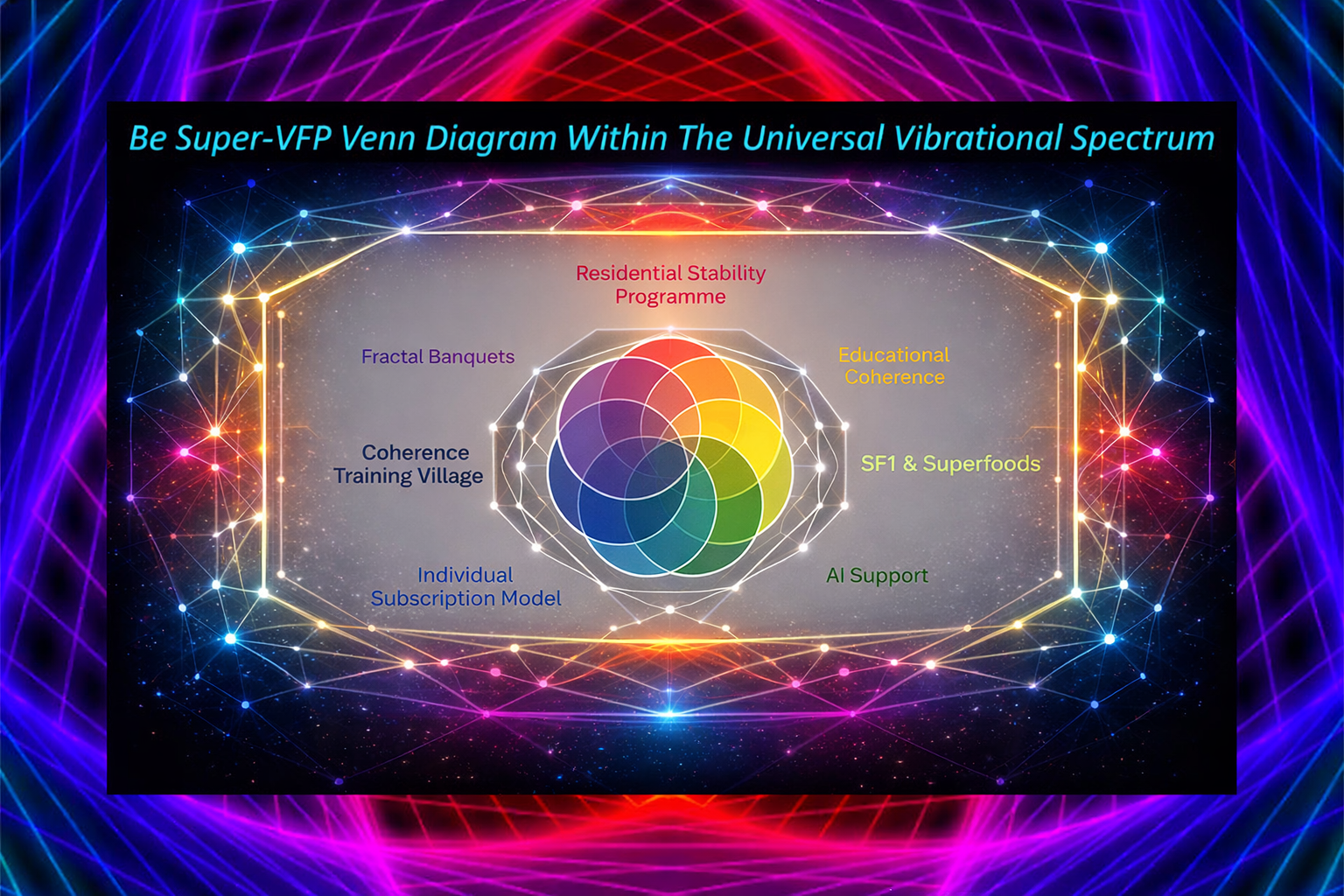
Be Super-VFP Venn Diagram and Practical Examples
This becomes useful when:
You want to understand how everything connects β
not as separate services,
but as one system.
πΏ A connected system β not separate services
This visual shows how different parts of life come together:
health
learning
support
environment
community
Not as separate services β
but as one connected system.
At the centre of that system is something simple:
how people feel
how they connect
how they function β individually and together
πΏ What sits at the centre
In Be SuperβVFP, we work with something called Informational Energy.
This is not abstract.
It simply describes how these interact:
- your body
- your emotional state
- your thinking
- your relationships
Every individual β
and every group (or pod) β
is a living pattern within this system.
πΏ The missing layer β now made visible
Most systems support either:
- the individual
or - the organisation
Very few support the space in between:
π teams
π staff groups
π leadership units
π pods within real environments
This is what the central field represents.
πΏ Workforce Pods (and real-world teams)
This system now extends clearly into:
- workplaces
- schools and colleges
- residential settings
- sports teams
- public services (NHS, police, local authorities)
- community groups
Here, the focus is not performance first.
It is:
stability β readiness β clear functioning β aligned action
πΏ What this allows (for organisations)
When individuals are supported in isolation, change is limited.
When pods stabilise together, something different happens:
- pressure reduces across the group
- communication becomes clearer
- reactivity lowers
- decision-making improves
- consistency increases
- leadership becomes easier to hold
This benefits:
π the individual
π the team
π and the organisation itself
πΏ Not a perk system
This is not:
- a reward platform
- a wellbeing add-on
- a referral system to external services
It is a coherence infrastructure
that sits within the organisation.
Supporting how people actually function β day to day.
πΏ How the system connects
Each circle in the visual represents a domain:
- Residential Stability
- Educational Coherence (SuperTeaching)
- Nutrition (SF1 & Superfoods)
- AI-supported guidance
- Community (Fractal Banquets)
- Individual access (subscription model)
The centre is where they meet:
π the lived experience of people, in real environments
πΏ What this creates
When the system is used in the right order:
- individuals stabilise
- pods become coherent
- environments become more consistent
- outcomes improve β without being forced
This allows:
self-actualisation (individual)
and
pod-actualisation (together)
πΏ The aim
The aim is not to remove difficulty.
The aim is not to force change.
It is to create enough:
- safety
- awareness
- stability
So that people can:
- stay present
- think clearly
- relate effectively
- and move forward without fear leading
πΏ In simple terms
This system supports:
π how people function
π how teams function
π how environments stabilise
So that everything built on top of that
has a stronger foundation.
πΏ Where this works in real environments
This system is not designed for one type of person or one setting.
It works wherever people are required to function β
individually and together β under real conditions.
The environment may change.
The human pattern does not.
πΏ A shared pattern across all environments
Whether in sport, education, business, or care settings, the same pressures appear:
- inconsistent responses under stress
- communication breakdown
- emotional overload or withdrawal
- loss of clarity in decision-making
This is not a role problem.
It is a functioning problem.
This system works at that level.
πΏ How this looks in practice
The examples below show how the same system applies across different environments.
Sport (e.g. team environments)
Teams preparing for performance under pressure β physically, mentally, and relationally.
This supports:
- players arriving more regulated
- clearer communication during competition
- reduced emotional reactivity under pressure
- stronger trust across the team
- coaches maintaining consistency without escalation
π The result: performance improves because the system stabilises
Residential Childcare
High-responsibility environments where consistency and emotional steadiness are critical.
This supports:
- adults remaining regulated during challenge
- consistent responses across shifts and staff
- reduced burnout and emotional overload
- young people experiencing more stable relationships
- teams functioning as a coherent unit
π The result: stability becomes lived β not just policy
Educational Environments (Staff & Classrooms)
Schools and colleges where pressure, demand, and variation are constant.
This supports:
- teachers maintaining presence in difficult classrooms
- reduced escalation between staff and learners
- clearer thinking under workload pressure
- improved staff steadiness without removing accountability
- alignment across teams and departments
π The result: learning improves because the environment stabilises
Workforce & Enterprise Environments
This includes:
- corporate organisations and executive teams
- project teams and departments
- small business teams
- self-led and network-dependent ventures
These environments often appear different β but function in similar ways under pressure.
This supports:
- clearer thinking in decision-making
- less reactive communication under pressure
- stronger collaboration across roles and teams
- leadership that stabilises rather than transmits pressure
- consistent functioning during uncertainty
- reduced absenteeism and fewer lost working days
- improved focus, effort, and authentic engagement
When this is not addressed, organisations often experience:
- increased absenteeism and presenteeism
- delayed project completion
- interrupted workflow and loss of momentum
- reduced quality of output
- weaker customer or client experience
- financial loss and reputational impact
- growing perception of low support within teams
π The result: performance improves without increasing pressure β and hidden losses reduce
Small Teams & Interdependent Ventures
Close-knit environments where people rely heavily on one another β including partnerships, small businesses, and network-led models.
This supports:
- reduced interpersonal friction
- clearer communication and shared roles
- less emotional spill-over into decisions
- stronger shared direction
- a more sustainable pace of work
π The result: growth becomes sustainable without destabilising the people within it
πΏ What is consistent across all environments
In every setting, the pattern is the same:
- individuals stabilise
- pods (teams) become more coherent
- environments become more consistent
- outcomes improve β without being forced
πΏ In simple terms
This system does not depend on the type of organisation.
It depends on something more fundamental:
people who need to function together under pressure
When that becomes more stable β everything built on top of it improves.
πΏ A grounded closing thought
You donβt need to redesign your system.
You support the people within it β
and the system begins to change.